- calendar_today August 7, 2025
.
Ukrainian President Volodymyr Zelenskyy on Monday said he held a “good” conversation with U.S. President Donald Trump about the security guarantees issue for Ukraine as the war with Russia heads into its fourth year.
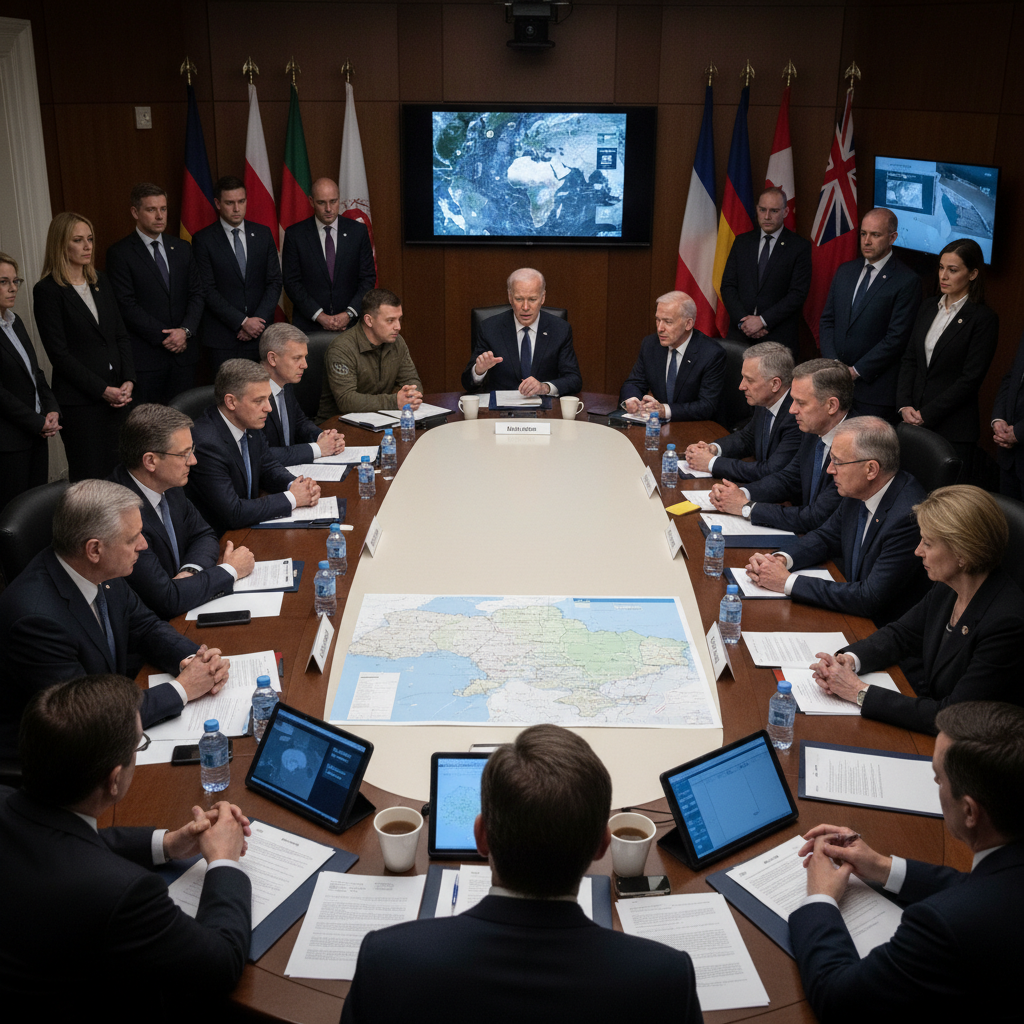
“The first one is security guarantees. And we are very happy with President [Trump], that all the leaders are here, and security in Ukraine depends on the United States and European countries,” Zelenskyy said at the White House, speaking alongside Trump and European leaders.
Addressing Ukrainian security guarantees as the war is poised to move into its fourth year, Zelenskyy said they are “still on the first line of Ukraine’s survival and future independent state.”
He added: “We received a clear message that the United States and our European partners are ready to send strong signals and steps, and we welcome this very much. This is very important.”
Zelenskyy, however, did not say what he wanted these security guarantees to look like. Trump said security was important, but stressed that Europe should take on the primary role, and that the conflict could not be resolved without difficult discussions over territory. “We’re going to help them, and we’re going to make it very secure,” Trump said. “We also need to discuss the possible exchanges of territory, taking into consideration the current line of contact. That means the war zone, the war line center.”
Leaders Meet at the White House as Divisions Emerge over Ukraine Support
The White House meeting came amid deep divisions among Western leaders over how to balance support for Ukraine with the push for a negotiated settlement to the war.
Trump has long been seen as far more open to territorial concessions for Ukraine than its leaders, who have repeatedly insisted that Ukraine’s sovereignty and internationally recognized borders must be preserved.
In Washington, where leaders were meeting to discuss security guarantees, U.S. lawmakers were sharpening their calls for more economic pressure on Russia and its trading partners. Senator Lindsey Graham, R-S.C., said the Trump administration should be considering more aggressive action against Moscow’s finances, specifically by targeting countries that continue to purchase Russian oil.
“The White House is overestimating its leverage and underestimating the importance of putting pressure on countries that are still buying oil from Russia,” Graham said on Fox News.
Graham is co-sponsoring legislation that would give Trump the ability to slap tariffs of up to 500 percent on countries continuing to do business with Russia.
“My advice to President Trump and [Secretary of State Marco Rubio] is, you’ve got to convince Putin that if this war doesn’t end justly and honorably with Ukraine making concessions also, we’re going to destroy the Russian economy,” Graham said. “The second most important person on the planet to end this war is President Xi in China.”
Graham added that Beijing “buys more oil than anybody in the world, so Xi controls this war to a significant degree. We’ve got to get President Xi to tell Putin to put the brakes on.”
Trump has already demonstrated a willingness to weaponize tariffs. He announced in August that he would impose a 50 percent tariff on India, in part due to its purchases of Russian oil. Graham suggested he would be open to a similar threat against China.
While U.S. lawmakers were calling for new action, the European Union was preparing to adopt its 19th sanctions round against Moscow. The measures, expected later this month, will focus on cutting off Russian energy revenues, further restricting Moscow’s access to banking and its military-industrial base, and closing gaps that have allowed Moscow to evade sanctions.
Russia is now by far the most sanctioned country in the world. According to the Global Sanctions Data, by the end of 2023, Moscow had become more isolated than any other country in modern history, with sanctions regimes targeting more individuals and sectors than in Iran, North Korea, or Venezuela.
Allies, though, have not just disagreed over the path to peace or the possible terms of a negotiated settlement. European leaders at the White House on Monday also pressed Trump on the need for a ceasefire before substantive negotiations could begin. German Chancellor Friedrich Merz argued that peace talks could only be given credibility if the fighting was temporarily halted.
“I can’t imagine that the next meeting would take place without a ceasefire,” Merz said. Trump pushed back, noting that five or six of the six peace agreements he claimed to have brokered in recent months had been achieved without any ceasefire in place.
“You have a ceasefire, and they rebuild and rebuild and rebuild,” Trump said, although he did admit that the main appeal of a truce was the immediate end to civilian casualties.
Taking office in March this year, Finnish President Alexander Stubb was among the leaders in Washington and also at the White House talks, having traveled from Finland for the summit. He has been skeptical of Russian President Vladimir Putin’s intentions and has openly questioned his willingness to respect any ceasefire. Stubb noted that Finland shares 800 miles of border with Russia, and has historical experience with Russia stretching back much further than Ukraine.
He said, however, that he was one of the European leaders with that Trump has been closest to working. “I think in Europe, I’m one of his best friends; we just share so many thoughts on so many topics,” Stubb said. He said that despite the current bleak picture, he was hopeful a solution could be found. “If I look at the silver lining of where we stand right now, we found a solution in 1944, and I’m sure that we’ll be able to find a solution in 2025 to end Russia’s war of aggression.”