
- calendar_today August 14, 2025
.
Electric vehicle adoption in the United States has hit another bump in the road. After accelerating for more than a year on a month-on-month basis, the sales of electric cars have started to contract. Genesis and Volvo are among the early adopters whose customers have shunned their electric products, leading both companies to revisit their product plans.
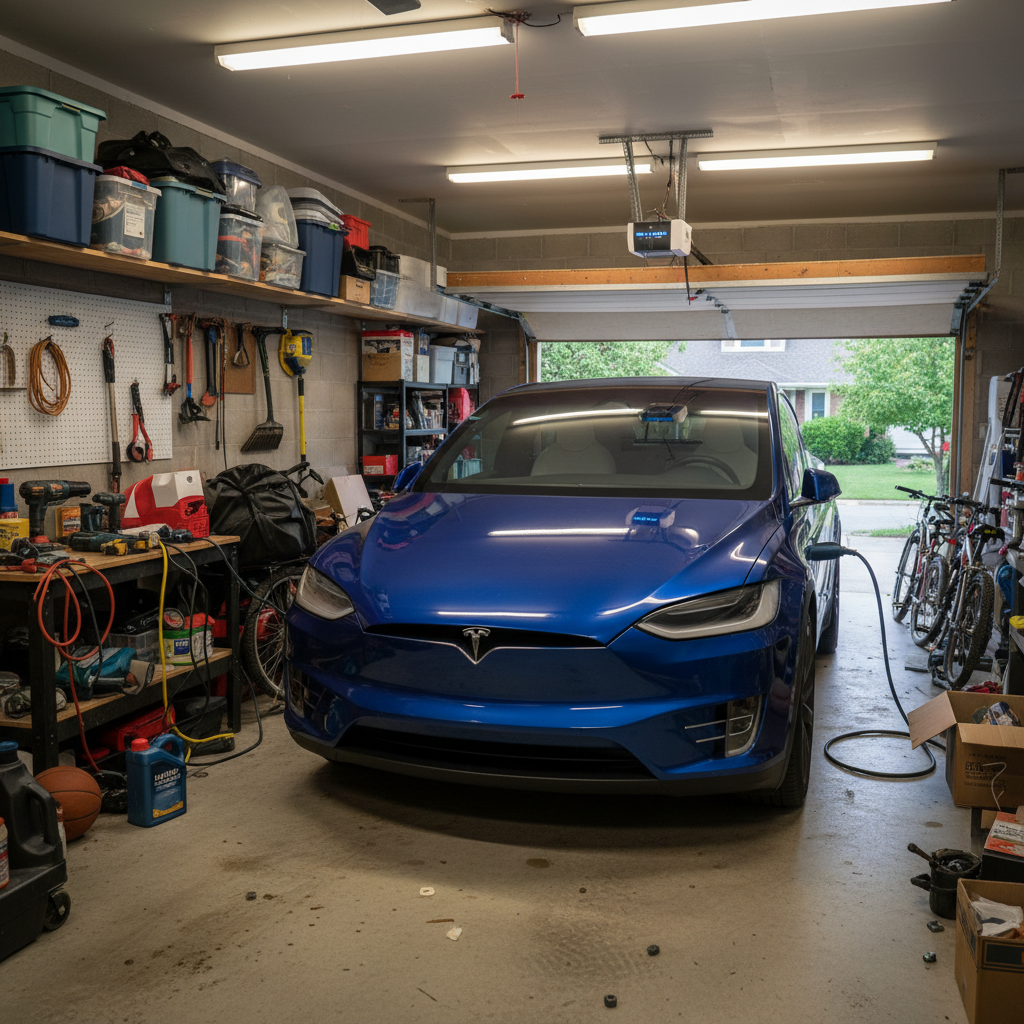
On top of this, political winds are also turning. While the Biden administration did boost federal subsidies, it has also curtailed automaker relief on vehicle pollution standards, leaving Americans with less support at the federal level. However, the electric vehicle (EV) researchers at Telemetry believe that the most significant hurdle to be found in Americans’ garages instead of the nation’s capital.
Parking Problems
For some time now, surveys have found range anxiety and charging access to be the leading barriers to EV adoption. Telemetry Vice President Sam Abuelsamid’s latest market research study explores the issue in depth, shining a light on one of the most overlooked problems related to charging: garage use.
EV charging at home is a story often outshone by headlines about fast-charging networks. Still, most drivers plug in their cars at night using level 1 (120-volt) and level 2 (240-volt) outlets with AC power, usually at a single-family residence (SFR). NREL data showed that 42 percent of SFRs already have a car parked next to an outlet capable of supporting level 2 charging.
That number could nearly double to 68 percent with some changes in homeowner behavior, namely clearing out garages and setting cars to park near a wall outlet. “90 percent of all houses can add a 240 V outlet near where cars could be parked. Parking behavior, namely whether homeowners use a private garage for parking or storage, will likely become a key factor in EV adoption,” states Abuelsamid in a press release.
Opening up garages for cars instead of storing random items could increase the number of SFRs capable of supporting EV charging from 31 million to over 50 million. Including houses that are too tight to add an outlet but can afford new wiring, that figure could balloon to over 72 million, easily surpassing even Telemetry’s most bullish EV penetration forecast of 33–57 million vehicles by 2035.
On paper, though, that doesn’t mean that the number of EV-ready homes is prepared to charge cars in practice. The same NREL study found that nearly 34 million U.S. houses need electrical system upgrades to support a level 2 charger, which typically requires a circuit of at least 30 amps. Upgrades can range from new wiring to full panel replacements and cost thousands of dollars.
In a nutshell, this analysis debunks one of the key arguments for electric cars: their purported affordability relative to gas-powered vehicles over the long term. Add the cost of charging installation into the price of an EV, and the total cost of ownership can quickly approach, if not exceed, those of traditional vehicles.
The situation for the 23 percent of Americans in multifamily residences (condos, apartments, townhomes, and so on) is even less favorable. Individual owners of EVs living in multifamily dwellings can rarely install chargers by themselves, as they must receive consent from the landlord or property management company (or condo/co-op boards for condos). The approval is far from a given, though.
The financial challenge in multifamily properties can also be significant. In a co-op, for instance, installing two shared level 2 chargers may need a full electrical panel upgrade before work on the charging stations even begins. It’s a job that could cost in the millions. Running wiring to spaces far from a source outlet doesn’t help. Unlike those in single-family homes, those in multiunit dwellings rarely qualify for any kind of municipal or utility installation subsidies either.
Today, around 1 million EVs are in multifamily dwellings, but only 11 percent of them can park close enough to an outlet to charge at home. Some states are requiring new developments to make 20–25 percent of parking spaces EV ready. Nevertheless, Telemetry estimates that there will be only 6.7–11.4 million charging-capable spaces in multifamily dwellings by 2035. This total is still short of demand.
Public Charging Infrastructure Woes
The limits of home charging explain why public charging infrastructure will be crucial. Telemetry’s estimate is that 11.7–14.3 million EV drivers who live in a house with a yard will still need public charging in 2035. A further 7.8–8.1 million EV drivers who live in multifamily housing will also need to use public chargers.
Meeting this public charging demand means deploying between 523,000 and 586,000 DC fast chargers nationwide, as well as another 1.5–1.6 million level 2 chargers. However, expanding this infrastructure will also encounter its own limits. Power companies are already straining under demand from new AI data centers that require a lot of generation and distribution capacity. They may not be keen to accommodate the rollout of large-scale charging sites, whether residential or public.
EVs remain very much in fashion. Some believe that President Biden is preparing to champion a new EV boom through executive actions such as a mandate for all vehicles to be sold emissions-free. Others continue to believe that EVs will go mainstream much sooner than forecast. However, real-world obstacles abound between this rosy vision and reality in the U.S. market.
Millions of homes could install the necessary electrical outlet in theory, but cluttered garages, the high costs of electrical upgrades, and the difficulties of multifamily living could all slow EV adoption. The resulting gap between demand and supply is only partially covered by the planned expansion of public charging. It could well exceed it in the next decade.