
- calendar_today August 20, 2025
.
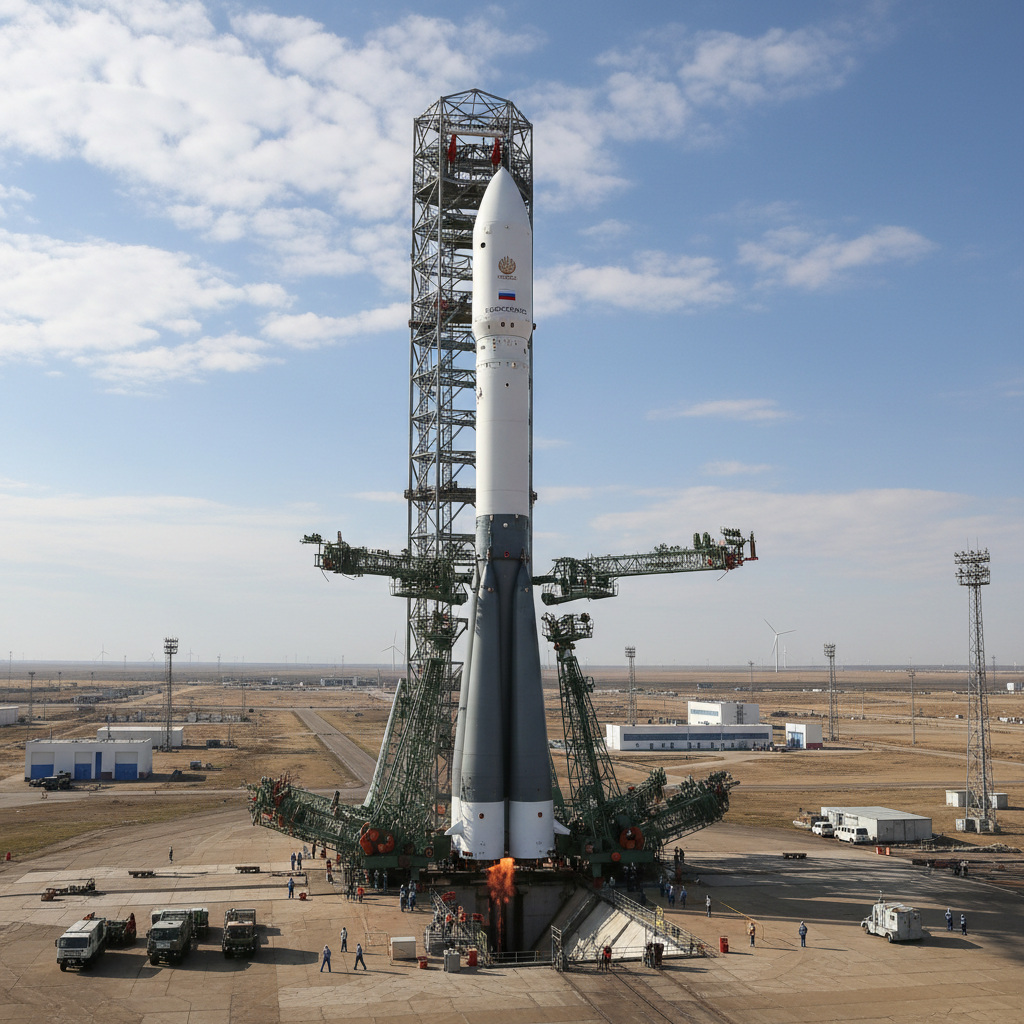
Russia is reportedly set to fly its latest rocket before the end of this year. Dmitry Bakanov, head of Russian space agency Roscosmos, said this week that the Soyuz-5 vehicle is due to take off as early as December. “Yes, we are planning for December,” Bakanov told state news agency TASS in an interview, adding that preparations for the rocket’s maiden flight are in “advanced stages.” The Soyuz-5 launch vehicle will operate from the Baikonur cosmodrome in Kazakhstan. If all goes as planned, the flight will be the first test flight of a rocket that has been in development for more than a decade. Roscosmos has said it plans several such trial launches. Commercial service is not expected before 2028.
The Soyuz-5, also known as Irtysh, does not represent a new approach to launch design. The new rocket is a cleanroom copy of the Zenit-2, a design that first flew in the 1980s and was developed by Ukraine’s Yuzhnoye Design Bureau. Zenit rockets themselves were built in Ukraine, but they always used Russian RD-171 engines for their first stage. For most of their operational history, Zenit was one of the few rocket systems built through cooperation between Russian and Ukrainian aerospace firms. The shared launch system withstood multiple crises, but not Russia’s 2022 invasion of Ukraine. In late 2023, Russia launched a missile strike on the factory where Zenit vehicles were once assembled.
As such, Soyuz-5 is a much larger and domestically manufactured Zenit. Roscosmos’s redesign of the Zenit-2 effectively rids the rocket of Ukrainian involvement, eliminating all key technical components produced in Russia. For Roscosmos, that’s a major strategic win, as it comes after years of dependency while also allowing the agency to replace its aging Proton-M launcher.
Soyuz-5: A Bridge Between Past and Future
The Soyuz-5 in itself is a medium-lift launch vehicle. The rocket is able to carry about 17 metric tons to low-Earth orbit (LEO). Roscosmos has achieved this performance by increasing the size of the propellant tanks slightly over the Zenit model. But the biggest difference lies within the Soyuz-5’s first stage. At its heart is the RD-171MV engine, the latest and most powerful member of the famous rocket engine family.
The RD-171MV’s lineage can be traced back to the Energia heavy-lift rocket program of the 1980s. Energia was an equally short-lived Soviet program that flew the Soviet Union’s space shuttle, Buran. The most recent RD-171MV stands out in one respect: it does not use any Ukrainian parts. The engine is a kerosene and liquid oxygen-fueled engine that produces over three times the thrust of the main engine used in NASA’s Space Shuttle. It is also the world’s most powerful liquid-fueled rocket engine still in operation.
In spite of its power, the Soyuz-5 is an expendable rocket. By contrast, all of its modern competitors have been built with reusability in mind. Most notably, SpaceX’s Falcon 9 rockets are not only reusable; they’ve also proven much cheaper and more flexible. That history casts doubt on whether Soyuz-5 is likely to ever capture a significant slice of the commercial international market.
For Roscosmos, however, Soyuz-5 plays a different role. With little funding available for new projects thanks to the war effort and international sanctions, designing a new rocket from scratch—let alone a reusable one—has proven difficult. The Amur rocket, also called Soyuz-7, was designed as an answer to this very issue. A vehicle with a reusable first stage and methane-fueled engines, Amur would be able to compete with SpaceX in cost. But the project’s development has suffered from constant delays, with the debut now pushed to at least 2030.
In the meantime, Soyuz-5 is a stopgap. It is enough to keep Roscosmos and Russia’s space industry in motion, even if that means it does so with older technology from the Soviet era. That said, the commercial prospects are less certain. In the last decade, the global launch industry has changed dramatically, with SpaceX and more recently Chinese launch providers offering cheaper, more flexible service than their Russian and European counterparts. Russia’s current fleet, for its part, remains split between Soyuz-2 rockets for crewed launches and the Angara family for heavier payloads. Neither has carved out much of an international niche, though, and it is not clear whether Soyuz-5 will be able to change that.
But Roscosmos has a track record of underdelivering, and bringing Soyuz-5 to the launch pad in such challenging circumstances would be a noteworthy feat on its own. A successful December launch would also show that Russia can still put new hardware on the launch pad despite international sanctions and a shrinking budget.
Soyuz-5 is no pioneer of new rocket technology. But for Russia, it has political and industrial significance. It is the country’s next step toward greater independence from foreign technology. It is also a bridge to the future, a future that for now remains the province of Amur and other upcoming rocket systems that have yet to be finalized.