- calendar_today August 7, 2025
Game Studios Struggle to Cope With Sudden Tariff Burden
If you make or publish board games in the U.S., you probably work in a creative, community-minded industry with small profit margins. As it turns out, that also makes you exactly the kind of person who was spooked this week by a newly announced 54 percent tax on goods made in China and imported to the United States.
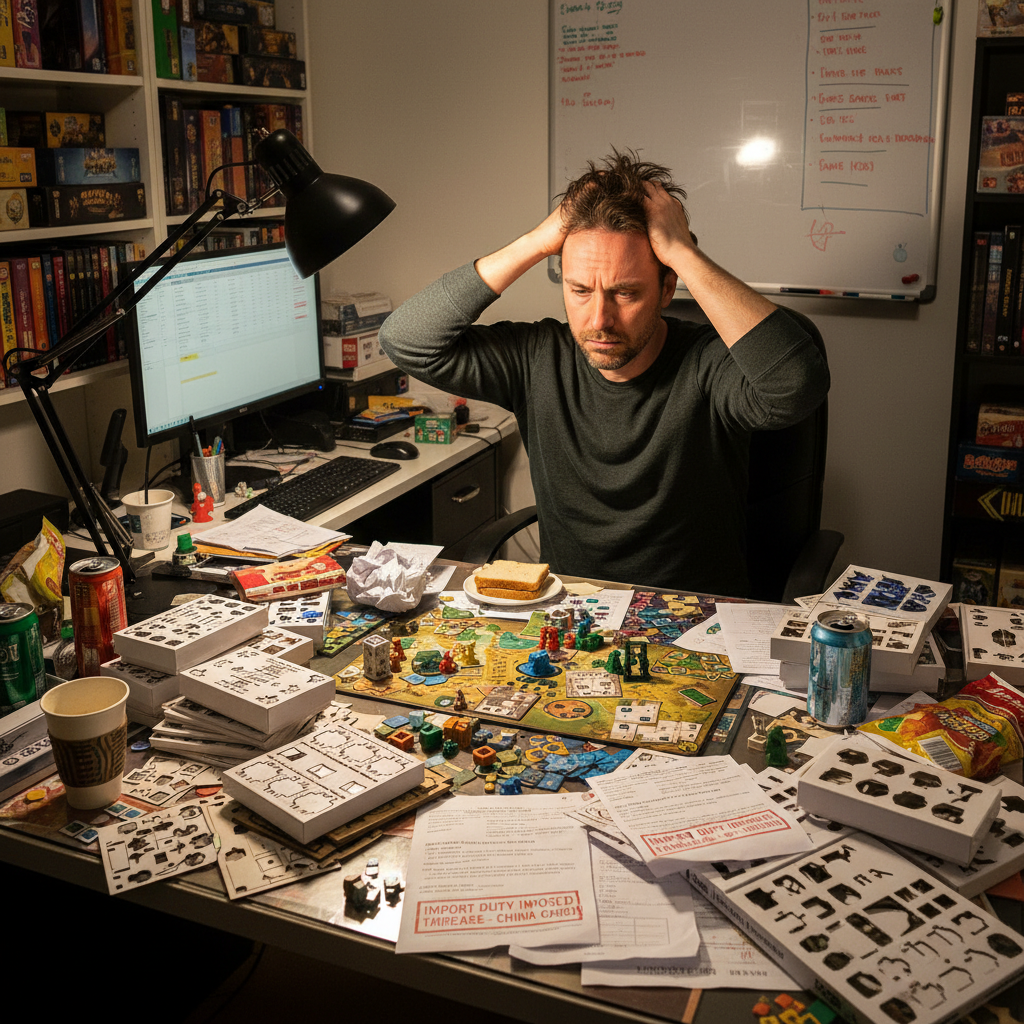
Jamey Stegmaier, the designer of games like Scythe and Wingspan, wrote in a personal blog post on Monday night that he was having trouble concentrating on his work.
“I tried to work on a new game I’m brainstorming last night,” Stegmaier wrote. “But it’s really hard to make something for the future when that future looks so grim. I mostly just found myself staring blankly at the enormity of the newly announced 54 percent tariff.”
The comment was notable not just for coming from one of the best-selling board game designers in the world, but also for how starkly it captured a sentiment that’s spread throughout the industry in recent days.
A Standard Production Pipeline, Interrupted
Manufacturing costs for American board games have long centered on China, for the same reason that many other consumer goods are made there. Europe, and Germany in particular, is a second hub for games, especially in niche tabletop circles: Germany is where Eurogame publishing giants like Fantasy Flight and Kosmos are based. But a factory in Germany or France is only useful for certain components of a board game, like printed cards. For something like custom plastic miniatures, wooden tokens or tiles, die-cut boards, or specialty dice, factories in China or other Asian countries are by far the most common solution.
It’s not for lack of trying. Domestic production of those components isn’t theoretically impossible, but it is functionally and prohibitively expensive, particularly for small to medium-sized publishers. Stegmaier, in his blog post, mentioned that he was once quoted $10 by a domestic manufacturer, “just for the empty box with our logo on it. The same $10 that, overseas, will cover the entire production and packaging of a game.”
In short, most companies in the U.S. publishing board games, especially small and medium-sized ones, just can’t afford a production pipeline that doesn’t involve factories in China. Which is why when Stegmaier, Placko, and other industry voices sounded the alarm over the coming 54 percent tariff, it was a big deal.
More Voices from the Board Game World
Designers and publishers are hardly the only ones decrying the move. Meredith Placko, CEO of Steve Jackson Games, the company behind games like Munchkin, wrote her note this week, capturing the same sense of being between a rock and a hard place shared by many in the industry.
“I get it, I do. This needs to be done,” Placko wrote in a post. “The issue, though, is that the infrastructure to support full-scale boardgame production—specialty dice making, die-cutting, custom plastic and wood components—doesn’t meaningfully exist here yet. I’ve gotten quotes. I’ve talked to factories. Even when the willingness is there, the equipment, labor, and timelines simply aren’t.”
The president of Restoration Games, Rob Daviau, who has designed and published several hit games, including Pandemic Legacy, has been warning his Twitter followers for months about what he and others in the industry see as an existential threat. On his blog, he’s noted that in recent weeks, “virtually every business meeting I have is an existential crisis about our industry.”
Retailers and Gamers Will Feel the Heat
Of course, in the end, it’s not just producers and publishers who make and sell board games who will feel the impact. Board gamers will, too, and it won’t be pretty. New releases are going to cost more; in some cases, publishers will try to save face by skimping on the quality of those products in other ways, and in others, they may simply decide to produce fewer of them.
Stores are also likely to suffer. Local game stores already struggle against Amazon, but if board gamers hunker down with their unplayed copies of A Game of Thrones on their “shelves of shame” (the parlance for so many board gamers) or shop online, local shops could see a particular hit.
“Within a few months, US companies will lose a lot of money and/or go out of business,” Stegmaier wrote. “And US citizens will suffer from extreme inflation.”
Workarounds? Fingers Crossed
In the long run, there may be some routes around the tariff for companies willing to ship games through distributors outside the U.S. (European publishers, for instance, will see less of a hit, which will make their distribution options in other countries more viable.) But that’s not much of a solution for American companies who, like Stegmaier’s Double Meamy, make a majority of their sales in the U.S. The Game Manufacturers Association, or GAMA, which represents board game publishers and manufacturers, has been active in trying to lobby the new tariff, so far without much success.
In the meantime, there’s frustration in the board game world about the nature of the situation itself, since, as with so many aspects of our current era, time seems to be a factor here. If a game hasn’t yet been designed or begun production, there’s some ability to plan for the new costs. But if it has, that’s a sunk cost, and there’s no getting around the new tariff on something that’s been shipped from China and is on its way.
Chris Solis, who runs a small studio in California, told Ars in an email that he has 8,000 games leaving a factory in China this week.
“The price I pay the factory is done. The only thing I can do now is scramble to cover the import bill,” Solis said.