
- calendar_today August 18, 2025
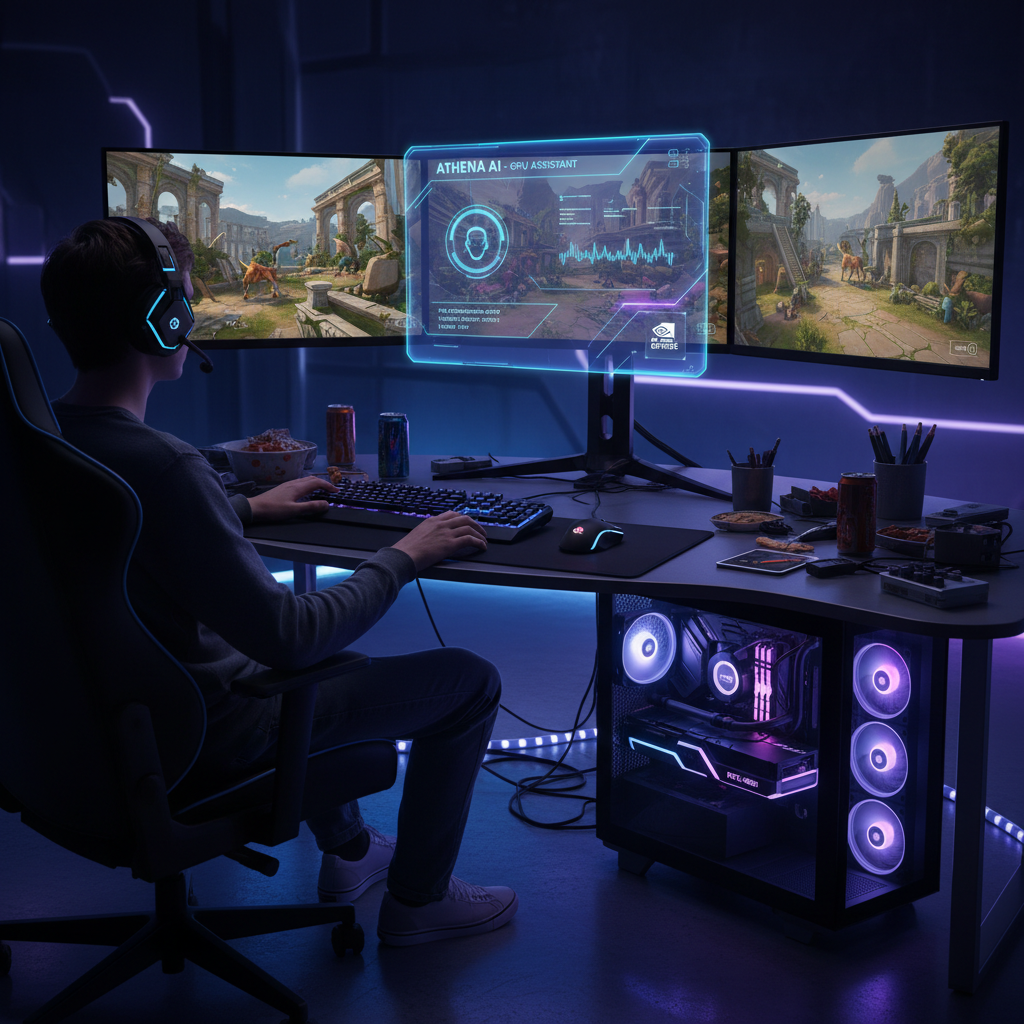
The leading graphics technology company, Nvidia, explores artificial intelligence integration to transform the gaming experience. Nvidia’s renowned GPUs for spectacular graphics performance now feature the company’s experimental G-Assist AI. This user-operated application optimizes PC performance and boosts gaming experiences through innovative methods while showcasing future potential for human-computer interactions.
Through an on-screen overlay in the Nvidia desktop application, users can communicate with an AI assistant using text or voice commands, which extends their control capabilities beyond standard system monitoring while potentially transforming how gamers interact with their system’s hardware and software.
Unveiling G-Assist’s Capabilities
The G-Assist software package provides multiple fascinating features that aim to optimize user gaming sessions. Users can submit broad inquiries, including “How does DLSS Frame Generation work?” and receive informative, AI-driven responses. The AI demonstrates its advanced capabilities by handling specific system-level configurations. When gamers enable G-Assist, they gain access to real-time system analysis through dynamic data charts that illustrate performance metrics. The AI system provides automated optimization capabilities by enabling users to adjust game settings and toggle system features. G-Assist provides GPU overclocking, which predicts performance outcomes to help users maximize their system potential through a simplified method for what has traditionally been a difficult procedure.
Limitations in Current Implementation
The public release demonstrates exciting features, but still does not match the depth of integration seen last year, where G-Assist provided in-game support. This more immersive level of integration is presently limited to a small selection of titles, with Ark: Survival Evolved being a key example.
Expanding Functionality with Plugins
Nvidia enhanced G-Assist capabilities by allowing third-party plug-ins to expand its functionality. The AI assistant can interface with peripherals from Logitech G, Corsair, MSI, and Nanoleaf to facilitate dynamic thermal profile adjustments and LED lighting synchronization, which expands its control beyond basic system settings.
Hardware and Performance Requirements
Nvidia seeks to highlight the built-in AI processing strengths of desktop systems with dedicated GPUs as the PC market develops towards “AI laptops”. Nvidia’s G-Assist functions locally to utilize the processing strength of GeForce RTX graphics cards, unlike many AI tools, which depend on cloud operations.
G-Assist uses a small language model (SLM) that runs locally to achieve quicker response times while also improving privacy. To install the basic text version, 3GB is needed, while the voice control feature requires an additional 3.5GB, which results in a total storage requirement of 6.5 GB. A GeForce RTX 30, 40, or 50 series GPU with no less than 12GB of VRAM is necessary for G-Assist to operate. System performance expands according to GPU strength, while future updates will include laptop GPU support.
Balancing Local Processing and Demands
Running G-Assist locally on the GPU leads to several benefits but also presents multiple challenges. Local processing capabilities enable enhanced privacy protection and lower latency, which speeds up user interactions. However, it also introduces performance considerations. Interacting with G-Assist caused a significant rise in GPU load when tested on an RTX 4070.
AI response generation requires significant computational power, which affects other tasks simultaneously running, especially graphic-intensive games. The frame rate in Baldur’s Gate 3 at maximum settings fell by around 20% when G-Assist processed data. Systems operating close to maximum capacity risk worsening performance bottlenecks when using G-Assist. G-Assist functions better when not running demanding games, but requires a powerful GPU for consistent heavy usage.
G-Assist demonstrates its experimental development stage through its sporadic performance issues and bug occurrences. Most users need to continue manually adjusting system and game settings because it remains the most effective method right now. G-Assist demonstrates a major advancement in utilizing the AI capabilities of gaming PCs and suggests a future scenario where GPUs deliver more interactive experiences.
The ongoing advancements in GPU technology make the combination of resource-intensive games with advanced AI models more feasible over time. Nvidia’s G-Assist offers an interesting preview of AI-enhanced gaming possibilities, which remains under development.